File:From Our Peace Teach-ins in 1969 to a First Earth Day in 1970.png
Original file (800 × 1,037 pixels, file size: 493 KB, MIME type: image/png)
Personal Memories on the 50th Anniversary of the First Earth Day
By Steven Schmidt

🌎
How did the environmental Teach-ins that turned into Earth Day spring up?
Senator Nelson later described how he came to put forward the idea of a teach-ins for environmentalism. He spoke of the mass movement of the 1969/70 Vietnam Moratorium and our strategy of a *series of actions over months focusing on pressuring Congress. He was struck how peace teach-ins worked to spread the word, he said, after a trip to California to see the huge oil spill on California’s coast in 1969 and then reading media headlines of the work of Moratorium activists.

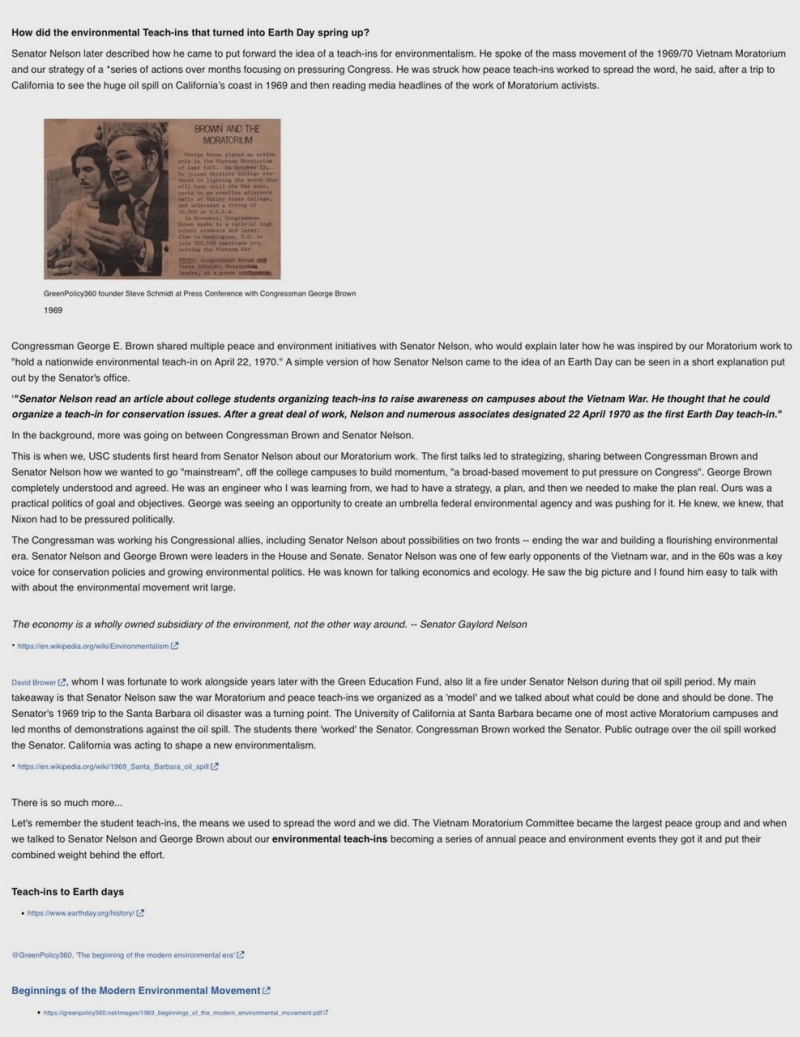
- GreenPolicy360 founder Steve Schmidt at Press Conference with Congressman George Brown
- 1969
Congressman George E. Brown shared multiple peace and environment initiatives with Senator Nelson, who would explain later how he was inspired by our Moratorium work to "hold a nationwide environmental teach-in on April 22, 1970." A simple version of how Senator Nelson came to the idea of an Earth Day can be seen in a short explanation put out by the Senator's office.
'"Senator Nelson read an article about college students organizing teach-ins to raise awareness on campuses about the Vietnam War. He thought that he could organize a teach-in for conservation issues. After a great deal of work, Nelson and numerous associates designated 22 April 1970 as the first Earth Day teach-in."
In the background, more was going on between Congressman Brown and Senator Nelson.
This is when we, USC students first heard from Senator Nelson about our Moratorium work. The first talks led to strategizing, sharing between Congressman Brown and Senator Nelson how we wanted to go "mainstream", off the college campuses to build momentum, "a broad-based movement to put pressure on Congress". George Brown completely understood and agreed. He was an engineer who I was learning from, we had to have a strategy, a plan, and then we needed to make the plan real. Ours was a practical politics of goal and objectives. George was seeing an opportunity to create an umbrella federal environmental agency and was pushing for it. He knew, we knew, that Nixon had to be pressured politically.
The Congressman was working his Congressional allies, including Senator Nelson about possibilities on two fronts -- ending the war and building a flourishing environmental era. Senator Nelson and George Brown were leaders in the House and Senate. Senator Nelson was one of few early opponents of the Vietnam war, and in the 60s was a key voice for conservation policies and growing environmental politics. He was known for talking economics and ecology. He saw the big picture and I found him easy to talk with with about the environmental movement writ large.
The economy is a wholly owned subsidiary of the environment, not the other way around. -- Senator Gaylord Nelson
• https://en.wikipedia.org/wiki/Environmentalism
David Brower, whom I was fortunate to work alongside years later with the Green Education Fund, also lit a fire under Senator Nelson during that oil spill period. My main takeaway is that Senator Nelson saw the war Moratorium and peace teach-ins we organized as a 'model' and we talked about what could be done and should be done. The Senator's 1969 trip to the Santa Barbara oil disaster was a turning point. The University of California at Santa Barbara became one of most active Moratorium campuses and led months of demonstrations against the oil spill. The students there 'worked' the Senator. Congressman Brown worked the Senator. Public outrage over the oil spill worked the Senator. California was acting to shape a new environmentalism.
• https://en.wikipedia.org/wiki/1969_Santa_Barbara_oil_spill
There is so much more...
Let's remember the student teach-ins, the means we used to spread the word and we did. The Vietnam Moratorium Committee became the largest peace group and and when we talked to Senator Nelson and George Brown about our environmental teach-ins becoming a series of annual peace and environment events they got it and put their combined weight behind the effort.
Teach-ins to Earth days

The Modern Environmental Movement
Beginnings of the Modern Environmental Movement
Earth Day 2020, 50 Years On...


- Original Art by 'OS' Olivia Schmidt / BY-NC-CC
🌎
File history
Click on a date/time to view the file as it appeared at that time.
| Date/Time | Thumbnail | Dimensions | User | Comment | |
|---|---|---|---|---|---|
| current | 19:28, 17 February 2025 | | 800 × 1,037 (493 KB) | Siterunner (talk | contribs) |
You cannot overwrite this file.
File usage
The following 8 pages use this file:

Metadata

- About Us
- Anthropocene
- Atmospheric Science
- Biodiversity
- Biosphere
- Citizen Science
- Civil Rights
- Clean Air
- Clean Water
- Climate Change
- Climate Policy
- Earth
- Eco-ethics
- Eco-nomics
- Eco-Spirituality
- Earth Day
- EOS eco Operating System
- Earth360
- EarthPOV
- Earth Observations
- Earth Science
- Ecofeminism
- Ecology Studies
- Education
- Energy
- Energy Policy
- Environmental Laws
- Environmental Movement
- Environmental Protection
- Environmental Security
- Environmental Security, National Security
- Food
- Global Security
- Global Warming
- Green Best Practices
- Green Networking
- GreenPolicy360
- Green Politics
- Health
- Human Rights
- Money in Politics
- Natural Resources
- Natural Rights
- Nature
- Networking
- New Definitions of National Security
- Overview Effect
- Peace
- Planet Citizen
- Planet Citizens
- Planet Scientist
- Planet Citizens, Planet Scientists
- Renewable Energy
- Resilience
- Seventh Generation Sustainability
- Solar Energy
- Strategic Demands
- Sustainability
- Sustainability Policies
- ThinBlueLayer
- US Environmental Protection Agency
- Water Quality
- Whole Earth
- Wildlife
- Women's Rights
- World Wide Web
- Youth